| Goenitz | Story | Move List | Gallery | Quotes | Trivia |
Overview

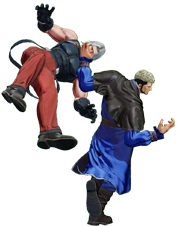
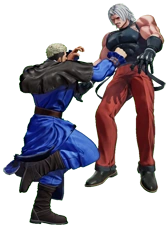
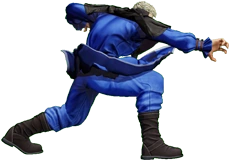
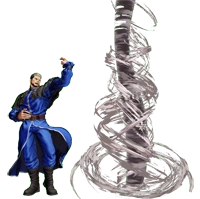
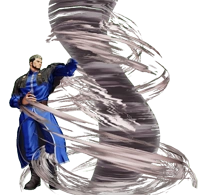
Originally the final opponent in The King of Fighters '96, Goenitz is an extremely unbalanced Zoning Character. He is considered to be one of the hardest bosses in SNK history, to the point he can actually become unbeatable depending on which strategy he decides to take. This is especially apparent in KOF XV where surprisingly, despite being a unbalanced zoner, he is extremely aggressive and can possibly infinite the player if he desires. The most dangerous move in his arsenal is his Yonokaze, a very quick move which can cover basically all of the visible stage, does heavy damage and cancels all projectiles, even Supers. It can appear wherever Goenitz chooses and there is no way to tell where it will spawn. Besides that, Goenitz has also strong and quick multi-hit moves like Wanhyou (Tokobuse or Mametsu variants) and Shin Kototsuki Souga. Additionally, he can also teleport with his Hyouga. The one way to beat Yonokaze is to try and bait it, as there exist some deadzones where the move cannot cover (especially in close-range).
As of his more balanced appearances in SvC Chaos, 2002 Unlimited Match and more so KOF XV, Goenitz is a dedicated-zoner as before but focuses much more on direct offense, with a bevy of strong jumping normals for solid short-hop approaches. Goenitz gains his advantages through forcing the foe to make small mistakes and gives him room to blow them up with potent vortexes and/or combo confirms (due to his fast movement speed and Hyouga). While his zoning isn't as obnoxious as it was in his boss versions, it is still potent enough to enforce his gameplan. With meter, his pressure and combo potential increases notably. He can be easily compared to Iori Yagami to a degree with his focus on instinctive vortexes and landing potent confirms, given the two of them share a number of techniques.
At a cost however, Goenitz's deadzones are still prevalent, and his grounded normals throughout the games are rather awkward to use (not being as potent as his jumping normals). But on direct defense, this added with his lack of meterless reversals and on-reaction anti-airs (crouching  does not cover as vertically as it looks), means that he does not have much assistance in getting calculated rushdown fighters off of him. Added with his tall frame, Goenitz is also forced to try and preemptively anti-air against deft aerial approaches that can force him into hesitation. This leads to his potent instinctive vortex game to come with a huge-risk-and-reward gameplay loop.
The King of Fighters series
 |
  or or  + + |
|||
or +  |
||||
 |
or + |
|||
 |
+  |
|||
 |
・ |
|||
 |
 + or + or  or or ( or or ( OK) OK) |
|||
 |
 + ( OK) + ( OK) |
|||
 |
+ |
|||
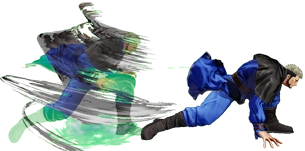 ГЁГА (Hyouga) 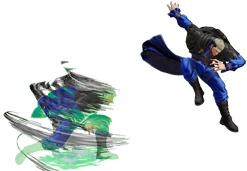 ГЁГА (Hyouga) |
 + or ( OK) + or ( OK) |
|||
 + or + or |
||||
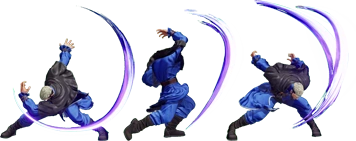 |
|
|||
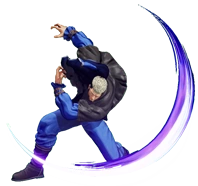 |
+ or ( OK) |
|||
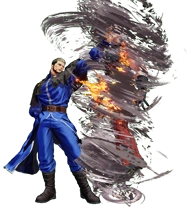 |
 + or ( + or ( OK) OK) |
version has Goenitz manifest another whirlwind blow after the initial attack. |
||
 |
 + or + or |
|||
 |
 + or + or |
|||
 |
+ |
|||
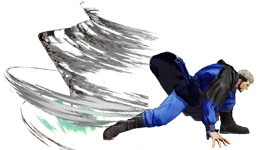 ЁМОЦУ (Yomotsu); 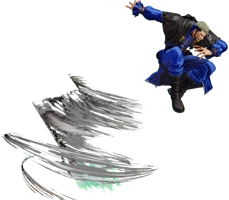
|
 + or ( OK) + or ( OK) |
/ versions) or teleports forward (with version). On a successful hit, he proceeds to slash at his foe while moving forward. He will finish by holding them up before ending it with a cross-claw attack. The version has Goenitz manifest a whirlwind that blows the opponent away as a follow-up to the cross-claw attack. |
||
 |
+ |
|||
 |
 + during Ibuki Nagayo + during Ibuki Nagayo |
|||
 |
+ |


.png)


SNK vs. Capcom series
| or + |
|||||
| or + |
|||||

|
+ or or or |
||||
 |
+ |
||||
 |
+ |
||||
| + or |
|||||
 |
+ or [x3] |
||||
| + |
|||||
| + or |
|||||
| + or |
|||||
| + or |
|||||
| |
+ or |
||||
| |
+ or |


Trivia
- Goenitz does not run, and instead dashes in. The different sound effect used reflects this behavior as well.
- The translations of his move names are approximate, since they are written in Cyrillic with hiragana (save for Shin Ya Otome, which is translated with kanji and only "Mizuchi" and "Jissoukoku" are written in Cyrillic in that case). The suspected kanji in light of the above translations with the Chinese version movelists as context are as follows:
- Meifu no Mon/Hell's Gate: 冥府の門
- Soukatsusatsu/Vitalizing Kill: 爽活殺
- Yomi e no Michi/Path to the Underworld: 黄泉への道
- Uranagi/Reverse Lull: 裏凪
- Oroshi/Mountain Wind: 颪
- Yonokaze/Wind of Night: 夜の風
- Wanhyou Tokobuse/Brachial Hail--Endless Collapse: 腕雹常伏
- Wanhyou Mametsu/Sagittal Hail--Steady Destruction: 弯氷磨滅 This is "sagittal" not as relating to the skull suture, but as relating to an arrow.
- Hyouga/Icy Creek: 氷河. The term normally means "glacier", but given the art's nature as a wind-aided teleport, a more literal translation seems to be called for.
- Shin Kototsuki: Souga/True Zither Moon: Claws and Fangs: 真琴月: 爪牙.
- Shin Aoihana: Seiran/True Hollyhock Flower: Azure Storm: 真葵花: 青嵐
- Shin Tsumakushi: Yoarashi/True Claw Comb: Night Storm: 真爪櫛: 夜嵐
- Yami Doukoku/Dark Lamentation: 闇慟哭. Chinese versions prefer to use "banka/elegy" (挽歌) likely as a double meaning.
- Shin Ya Otome: Mizuchi/True Eight Maidens: Mizuchi: 真八稚女: 蛟. A mizuchi is a young dragon, seen at that age as having cruel tendencies. As a result, the mizuchi is often a byword for flat cruelty.
- Shin Ya Otome: Jissoukoku/True Eight Maidens: Intrinsic Domination: 真八稚女: 実相剋. "Jissoukoku" appears to be a play on the Buddhist term "Jissougi" (實相義), referencing the nature of ultimate reality. Where 義/gi suggests a natural state of justice and virtue, 剋/koku instead suggests a natural state of dominance--given Goenitz's nature, of the strong doing all they please to the weak.
- Shin Ya Otome: Yomotsu/True Eight Maidens: Yellow Spring: 真八稚女: 黄泉. The Yomotsu marks the beginning of the Yomi no Kuni underworld--what the "Yomi" in "Yomi e no Michi" is shorthand for.
- Fuujin Ibuki/Wind God Breath: 風神息吹
- Ibuki Nagayo/Breath Eternal: 息吹永世
- Tokoshie no Kaze/Eternal Wind: 永恒の風